


Dive Sites
Boracay is blessed with crystal clear waters all around her dazzling white sand and rocky coastline. Reefs are mostly gentle slopes and shallow coral gardens but on the northern and southern ends you will encounter steep drop-offs and vertical walls alive with an amazing variety of reef inhabitants and pelagic hunters.
Explore these sites with our experienced and enthusiastic guides who will explain everything you wish to know about this colorful and exotic fauna.
The 7km long reef on Boracay’s western shore offers a variety of easy dives, ideal for training as they gradually slope deeper from 6m to 25m. Experienced divers will also feel at home here with plenty to enjoy as a relaxed reintroduction to tropical diving.


Angol Point
Angol Point is less than 10 minutes boat ride from Station 1, we will tie up on one of two mooring buoys and descend to the bottom at just 7m depth. The site is ideal for open water training dives and Discover Scuba Diving.
There are very nice patch reefs and pinnacles where we find very nice hard coral cover and numerous reef fish. We can also see plenty of feather stars with their hidden shrimps, nudibranchs and the odd ribbon eel.

Balinghai
About 12 minutes away by boat we have a choice of 2 moorings to tie up on. There is a large reef shelf from 7-12m deep leading to a 45° reef slope down to 18m. There is plenty of life along the slope with a large sandy area at the bottom with several coral heads. Here we find schooling fish, eels and bluespotted stingrays. There is also a deeper part encrusted with corals and home to many species of fish.

Camia II
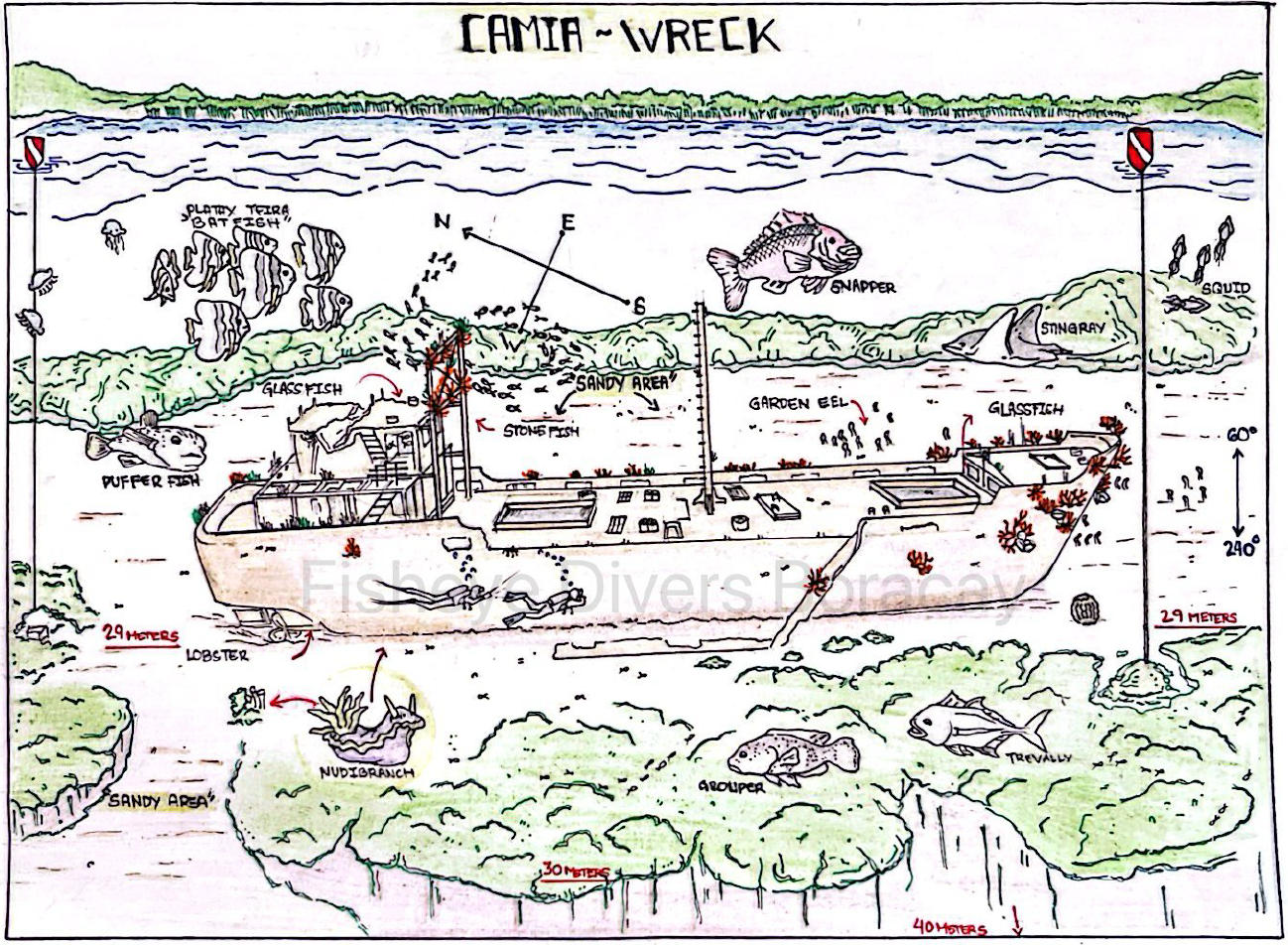
Camia is the first wreck sunk by BASS in 2001. She is 37m long and rests upon a sandy bottom, between coral heads at 28m depth.
Both hard and soft corals have grown rapidly and can be seen all over the vessel. Many interesting animals populate her structures and the life round and below the wreck has also seen a marked improvement.
The wreck can be safely penetrated and is an ideal location for divers to take their PADI Wreck Specialty. Camia is one of our most popular dive sites.
Camia II Ship wreck
Location: Southwest of Boracay Island, around Station 2-3 White Beach
Type: Artificial wreck dive / Coral-covered structure
Description:
The Camia Wreck is one of Boracay’s most famous dive sites — a 30-meter long cargo ship intentionally sunk in 2001 to create an artificial reef. Over the years, the wreck has become completely encrusted with corals and sponges, attracting an abundance of marine life. The structure remains mostly intact, offering divers an exciting opportunity to explore around the deck, engine area, and nearby reef. It’s a favorite site for both wreck and deep diving enthusiasts.
Depth:
• Top of wreck: ~18 meters
• Bottom: ~30 meters
Visibility:
15–25 meters
Current:
Mild to moderate, depending on season and tide
Marine Life (For Normal Divers):
• Schools of batfish circling the wreck,
• Giant Snappers, groupers, and trevallies
• Lionfish, scorpionfish, and moray eels hiding in the wreck
• Occasionally spotted turtles cruising by
• School of Fusiliers and surgeonfish swarming around the reef area
Macro Highlights:
• Nudibranchs decorating the hull, phyllodesmium longicirrum at sandy bottom, sea pen shrimp
• Ghost pipefish around coral growth( seasonal)
• Frogfish blending in with sponges( seasonal)
• Cleaner shrimp and small crabs inside openings
• Flatworms and small blennies on the wreck surface
Suitable For:
• Advanced Open Water Divers (due to depth)
• Wreck specialty divers
• Underwater photographers (ideal for both wide-angle wreck shots and macro close-ups)
Tips:
• Bring a dive torch to peek into dark sections — but avoid penetration unless properly trained.
• Stay alert for mild current when ascending or descending the line.
• Excellent site for Deep Diver and Wreck Diver training.
• Schools of fish often hover at the top — perfect for silhouette photography.

Channel Drift
This is a thrilling drift dive with fast current that runs through the channel between the islands of Boracay and Panay. The topography is multiple stair-like drop-offs, hence the name Channel Steps. Gorgonian fans, whips and barrel sponges are everywhere on the bottom, along with some rocks that give shelter to sweetlips and groupers.


Diniwid
Diniwid is a shallow coastal dive site in Boracay, popular for its calm conditions and beginner-friendly environment. The sandy seabed is interspersed with coral patches that shelter reef fish, nudibranchs, and small marine creatures. With gentle currents and clear water, it’s perfect for training, fun dives, and underwater photography.


Lobster Rock
Lobster Rock is a popular Boracay dive site known for its rocky formations and crevices that shelter lobsters, moray eels, and reef fish. With moderate depth and mild to occasionally stronger currents, it offers an exciting experience for certified divers, showcasing vibrant corals and diverse marine life in a scenic underwater setting.

Punta Bunga
The most interesting part of Punta Bunga stretches from 10 meters (33 feet) deep to 35 meters (120 feet).
It's an underwater paradise for macro photography, as well as for the underwater scenery photography. The videographer will also find their needs fulfilled because there is always something moving around, like the reef fishes shoaling on the corals and sea fans.

Santoson
When dropping over the beginning of the wall, numerous red-tooth triggerfish are usually seen. Along the wall itself, which drops off to around 20m, you can see emperors, groupers, eels and boxfish. When dropping over the beginning of the wall, numerous red-tooth triggerfish are usually seen. Along the wall itself, which drops off to around 20m, you can see emperors, groupers, eels and boxfish.


Tribird
In March 2012 the Boracay Association of Scubadiving Schools sunk a Russian Yak-40 passenger jet. The plane lays upside down on a sandy bottom at 28m depth. The seats have been removed allowing divers to dive safely through the aircraft.
The stepped reef around the plane allows us to explore the reef after seeing the plane and then finish the dive in a comfortable depth of 12 to 14m. Tribird is a great new addition to Boracay’s dive sites and we look forward to more fish taking up residence!


Yapak II
For most divers this is the star attraction of Boracay as it is the place with the most big fish and great corals. The sea can be choppy and the currents strong so it’s a must to have a checkup dive first and to have deep diving experience. We make a blue water descent to 32m which is the shallowest part of the dive and the start of the vertical drop off.
Along the edge of the wall there is a great coral cover where we can see snappers, tunas, jackfish, sharks, rays, groupers and turtles!